Jared Kushner spoke about Russian election interference during the Time 100 Summit 2019 in New York City. Credit: Brian Ach/Getty Images for Time
I’m pretty much done characterizing Donald Trump. There’s long been nothing more to learn about this man that people don’t already know.
Jared Kushner, on the other hand, is a different story. He lays low and has an ounce of measured judgement about when to open his mouth in public. Combine that with his immediate proximity to Trump on all fronts, and the curiosity of his influence, if any, is strong.
To date, Kushner has done nothing to distinguish himself from the tribe. That does not mean he isn’t instrumental behind the scenes, and a meaningful influencer of how our country moves forward, or backward.
At best, he is what he projects-a docile, entitled elite, with little more than a dilettante’s interest in mixing it up with politics or governance. At worst, he is a charade of a diplomat concealing a hard-core, cold blooded capitalist with malleable ethical and legal boundaries, and questionable instincts to anchor thoughtful judgement on complex issues.
Even if he is parts of both, his rare public comments are not encouraging.
FACT CHECK: Russian Interference Went Far Beyond ‘Facebook Ads’ Kushner Described
Via NPR, Miles Parks
In a rare public appearance on Tuesday, Jared Kushner, President Trump’s son-in-law and one of his closest advisers, said that the multiple investigations into Russian election interference have been more harmful to American democracy than the original interference itself.
“The whole thing is just a big distraction for the country,” Kushner said at a Time magazine event in New York City. “You look at what Russia did — buying some Facebook ads to try and sow dissent. And it’s a terrible thing, but I think the investigation and all the speculation that’s happened over the past two years has had a much harsher impact on our democracy.”
In describing Russia’s efforts leading up to the 2016 election, Kushner emphasized what he called the relatively small amount of money Russian agents spent advertising on social media.
“They said they spent $160,000. I spent $160,000 on Facebook in three hours during the campaign,” Kushner said. “If you look at the magnitude of what they did and what they accomplished, I think the ensuing investigations have been way more harmful to our country.”
Fact check: Were Facebook ads the extent of Russian election interference?
The short answer: No.
The long answer: The redacted version of Justice Department special counsel Robert Mueller’s report revealed a years-long plot by the Russian government to interfere in the U.S. that investigators called “sweeping and systemic.”
As to the amount of money expended on Facebook ads, the company said Russian operatives did spend less than $200,000 on advertising on the platform — but that doesn’t account for the organic content the operatives created and shared.
Not only were influence specialists within Russia’s Internet Research Agency purchasing normal advertisements, they were authoring their own posts, memes and other content as they posed as American users.
They also reached out to politically active Americans, posing as like-minded supporters, and helped organize rallies and other events in the real world.
Facebook says the Internet Research Agency may have reached as many as 126 million people. Separately, Twitter announced that about 1.4 million people may have been in contact with IRA-controlled accounts.
The social media aspect of the interference was just one dimension. Cyberattackers also went after political victims in the United States — whose emails and other data were released publicly to embarrass them — and state elections officials and other targets. And there may have been other avenues of interference as well.
The origins of the scheme
Russian operatives lied to get into the U.S. as early as 2014 on “intelligence-gathering missions.” They traveled across the country to get the lay of the land before ramping up efforts to try to interfere with American politics.
By September 2016, two months before the U.S. presidential election, the Internet Research Agency was working with an overall monthly budget that reached over $1.25 million. It employed hundreds of employees, a graphics department, a data analysis department, a search-engine optimization department, an IT department and a finance department, according to an indictment filed last year by Mueller’s team.
And it hasn’t stopped.
The U.S. military reportedly blocked the Internet access of the IRA during last year’s midterm elections to keep it from interfering with the midterm election. U.S. Cyber Command also targeted Russian cyber operatives, according to a report by The New York Times, with direct messages letting them know that American intelligence was tracking them.
And in October, a Russian woman was accused, according to a criminal complaint filed in federal court, of conspiring to sow discord and division in the U.S political system.
That conspiracy, the complaint said, “continues to this day.”
Buy something on Amazon and want to send it back? Kohl’s will take it off your hands for you. The department store chain announced Wednesday that starting in July, it will accept Amazon returns at all of its 1,150 stores.
Kohl’s says it will accept “eligible Amazon items, without a box or label, and return them for customers for free.” The program will expand a pilot introduced at Kohl’s stores in the Los Angeles, Chicago and Milwaukee markets in 2017.
The move highlights a major headache of shopping online: You often can’t try something before you buy it, and if the item doesn’t work out, it can be a hassle to return it.
The Kohl’s-Amazon partnership offers one solution, at least for people with a Kohl’s nearby. (Kohl’s stores are often located in suburban strip malls, not city centers, so the partnership won’t help many carless urbanites.)
And why might Kohl’s want to partner with its online competitor? Foot traffic and new customers. If Amazon shoppers go to Kohl’s to make a return, perhaps they’ll pick up a few items while they’re at it.
The United States is having its worst year for measles since the disease was declared eliminated in the country in 2000. Federal health officials said Wednesday that 695 individual cases have been confirmed in 22 states in 2019.
The growing number reflects the rise of the antivaccination movement in the country and the spread of international outbreaks that have infected American travelers.
New York has been particularly hard hit, with 200 confirmed reported cases in suburban Rockland County, and at least 334 cases in New York City, almost all in Brooklyn. This week, public health officials in Los Angeles declared a measles outbreak in the county, making it the latest metropolitan area to be hit by the illness.
Five cases of measles are being investigated there. California requires childhood immunizations to attend public or private school, with exemptions allowed if a doctor confirms that there is a medical reason to not have all or some shots. It is one of the strictest laws in the country.
Here’s what you need to know about the disease and the risk of getting it.
What is measles?
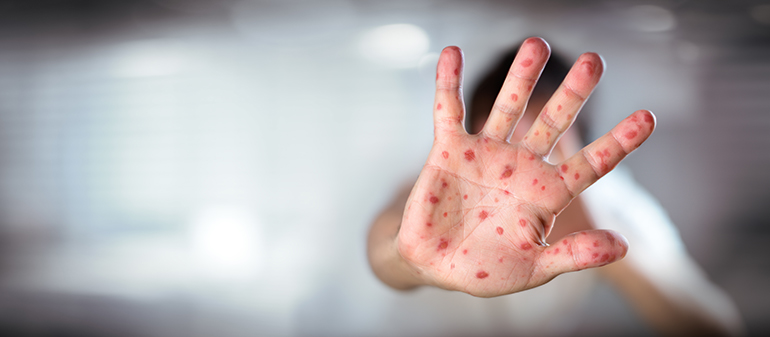
Measles is an extremely contagious virus. It can cause serious respiratory symptoms, fever and rash. In some cases, especially in babies and young children, the consequences can be severe. Measles killed 110,000 people globally in 2017, mostly children under 5.
According to the Centers for Disease Control and Prevention, one in 10 children with measles gets an ear infection, which can lead to permanent deafness. One in 20 children with measles develops pneumonia and one in 1,000 develops encephalitis (brain swelling that can cause brain damage). Pregnant women with measles are at greater risk of having premature or low-birth-weight babies.
One or two in 1,000 children who contract measles will die. In countries where measles vaccination is not routine, it is a significant cause of death, according to the World Health Organization.
How is measles transmitted?
Measles is transmitted by droplets from an infected person’s nose or mouth. If you’re in a room with someone infected with measles, you can inhale their virus when they cough, sneeze or even talk. Infected people can transmit the measles virus starting four days before they develop a rash, so they may be contagious before they realize they have the disease. They remain able to spread the virus for about four days after the rash appears.
The virus can also live on surfaces for several hours, and is so contagious that, according to the C.D.C., “you can catch measles just by being in a room where a person with measles has been, up to two hours after that person is gone.”
What are the symptoms of measles?
According to the Mayo Clinic, people show no symptoms up to two weeks after being infected. Then they develop symptoms typical of a cold or virus: moderate fever, cough, sore throat, runny nose, red and swollen eyes.
But after two or three days of that, fever spikes to 104 or 105 degrees and the telltale red dots appear on the skin, first on the face, then spreading down the body.
Abel Zhang, 1, being helped back into his clothes by his mother, Wenyi Zhang, center, his grandmother, Ding Hong, left, and Dr. Lauren Lawler, after receiving inoculations for measles, mumps and rubella at a clinic in Seattle. Credit: Elaine Thompson/Associated Press
Is there a cure for measles?
No. The vast majority of people who contract measles haven’t been vaccinated, and giving them the measles vaccine within 72 hours of being exposed to the virus might help — at least by reducing the severity and duration of the symptoms. The Mayo Clinic says that pregnant women, babies and people with weak immune systems can receive an injection of antibodies called immune serum globulin within six days of being exposed to measles, which might prevent or lessen the symptoms.
How safe and effective is the measles vaccine?
Extremely safe and effective. The measles-mumps-rubella (M.M.R.) vaccine causes no side effects in most children. Small numbers may get a mild fever, rash, soreness or swelling, the C.D.C. says. Adults or teenagers may feel temporary soreness or stiffness at the injection site. Rarely, the vaccine might cause a high fever that could lead to a seizure, according to the C.D.C. Contrary to misinformation that some anti-vaccine activists continue to repeat, the vaccine does not cause autism.
Children should receive two doses of the vaccine: the first when they are 12 to 15 months old; the second when they are between 4 and 6 years old. If infants who are between 6 and 11 months old are about to travel from the United States to another country, the C.D.C. recommends they receive one dose of the vaccine beforehand.
People who don’t get the vaccine are at very high risk for contracting measles. “Almost everyone who has not had the MMR shot will get measles if they are exposed to the measles virus,” the C.D.C. says.
If I’m not vaccinated, is it too late to get the shot?
It’s not too late. In fact, if measles is occurring in your community, it’s a good idea to get vaccinated unless you are sure you have previously received two shots of the M.M.R. vaccine; or you’ve had all three of the diseases the vaccine protects against (which gives you lifelong immunity); or you were born before 1957. (The vaccine was made available in 1963 and in the decade before that, virtually every child got measles by age 15, so the C.D.C. considers people born before 1957 likely to have had measles as children.)
But people who received the vaccine in the 1960s should consider getting immunized again. One of two vaccines available from 1963-67 was ineffective, the C.D.C. says. The effective vaccine during those years was the “live” vaccine; the ineffective one was the inactivated or “killed” vaccine. If you’re not sure, consult with your doctor.
If most people are getting vaccinated, why does it matter if I don’t vaccinate my child?
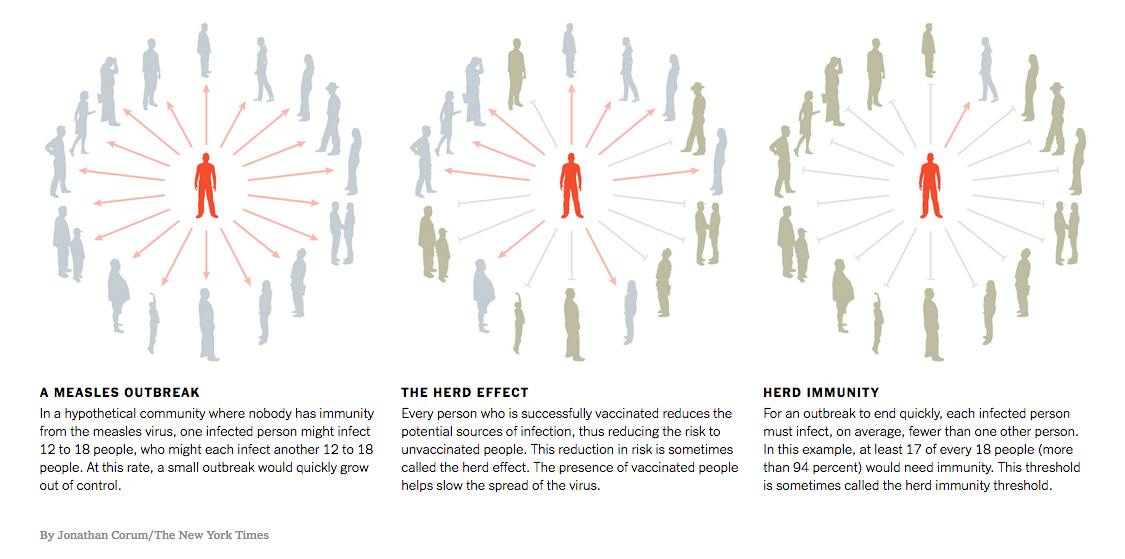
You are probably thinking of the concept of herd immunity, which means that if a large number of people are protected from a disease by a vaccine, the disease will be less likely to circulate, diminishing the risk for people who are unvaccinated. The threshold for herd immunity varies by disease — for a highly contagious disease, a very high percentage of people need to be vaccinated to meet that threshold.
Because measles is so contagious, between 93 percent and 95 percent of people in a community need to be vaccinated to achieve herd immunity. Remember, some people can’t be vaccinated for medical reasons: infants, pregnant women and people who are immune compromised.
During the Disneyland outbreak in 2015, a 9-month-old child whose parents were planning to immunize contracted measles from an older child who hadn’t been vaccinated, said Dr. Annabelle De St. Maurice, an expert on infectious diseases at U.C.L.A. So vaccinating your child not only protects your child, it helps protect others in your community.
Wait, didn’t we eliminate measles?
In 2000, measles was declared eliminated from the United States because the country had gone for more than 12 months without any “continuous disease transmission” within its borders. “Eliminated” doesn’t mean the disease was completely eradicated; it means the United States no longer had any places where the disease was endemic or homegrown.
There have been a small number of measles cases in the United States since then, ranging from 37 in 2004 to 667 in 2014, largely among people who were not vaccinated.
Most of the American cases since 2000 have been the result of people traveling to or from countries where measles is endemic because there is little vaccination.
How many people haven’t been vaccinated?
A small number in scattered pockets. Measles immunization in the United States is stable and high — more than 90 percent — according to C.D.C. tracking.
Who are the people not getting vaccinated?
One way to measure is by looking at the annual assessment of kindergarten vaccinations. It shows only Colorado, the District of Columbia, Idaho and Kansas dipping below the national 90 percent vaccination rate, though in certain communities the rate can be lower.
Generally, those who do not immunize their children are demographically more white and more educated, Dr. De St. Maurice said. “In part due to the success of vaccines, people are not as familiar with these diseases, so they question their effectiveness,” she said. Conversely, when the disease reappears, as it did in Washington, demand for vaccines rises.
Don’t states have laws requiring parents to vaccinate their children?
Every state has these laws. Three states allow only medical exemptions: Mississippi, West Virginia and, more recently, California, following the Disneyland outbreak. The rest grant exemptions for personal, philosophical or religious beliefs as well.
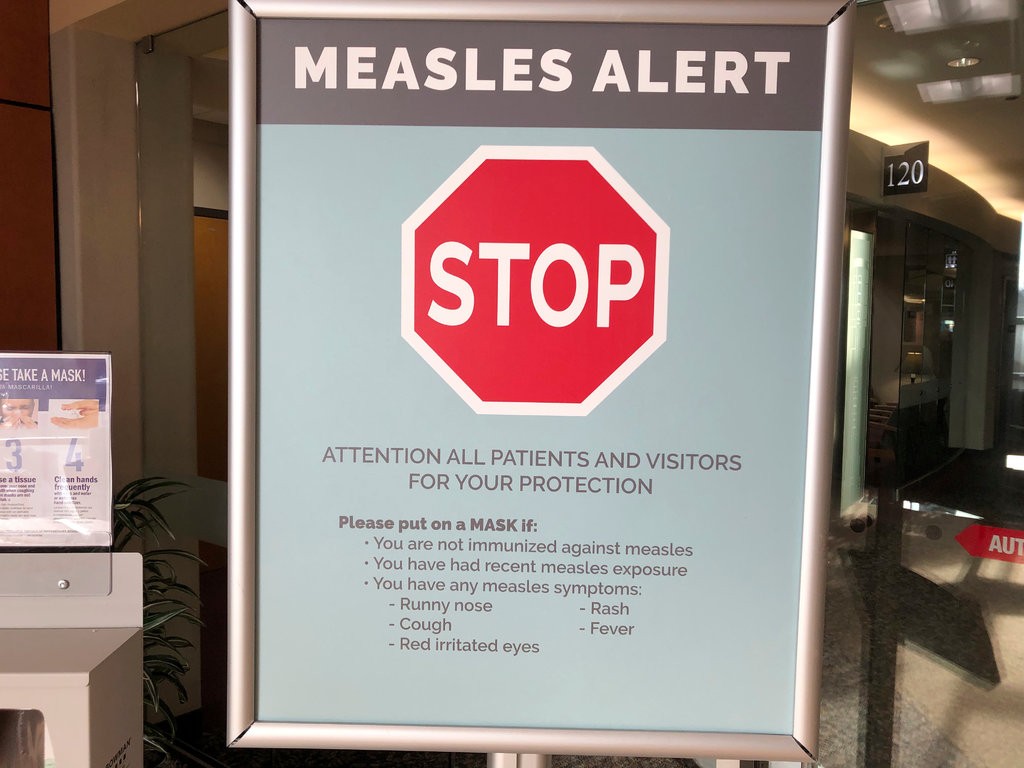
Signs warning patients at a clinic in Vancouver, Wash.Credit: Gillian Flaccus/Associated Press
Are the states with lax laws the ones with the most measles cases?
There have not been enough cases to warrant a major survey, but Dr. Saad Omer of the Emory Vaccine Center in Atlanta warned that with a rising number of cases, that could change.
Dr. Omer, who studies immunization coverage and disease incidence, said research had shown that states that allow more exemptions have increased pertussis (whooping cough) outbreaks.
Studies have also shown that people who refuse vaccines are disproportionately represented in the early stage of outbreaks. “They’re providing the tinder that can start the fires of the epidemics,” Dr. Omer said.
How does the U.S. compare with other countries?
Measles cases have been increasing around the world, too. Worldwide, there was an 80 percent drop in measles deaths from 2000 through 2017. But reported cases of measles have increased 30 percent since 2016, according to the World Health Organization.
Ninety-four percent of children in the United States get the recommended two-dose vaccine. According to the World Health Organization, more than a dozen countries reached the 99 percent mark, including Cuba, China, Morocco and Uzbekistan. Canada, Britain and Switzerland are a few of the Western countries that are below 90 percent.
In Europe overall, only about 90 percent of children receive the recommended two-dose vaccine. Worldwide, about 85 percent of children receive the first dose, but the number drops to 67 percent for a second dose, data shows.
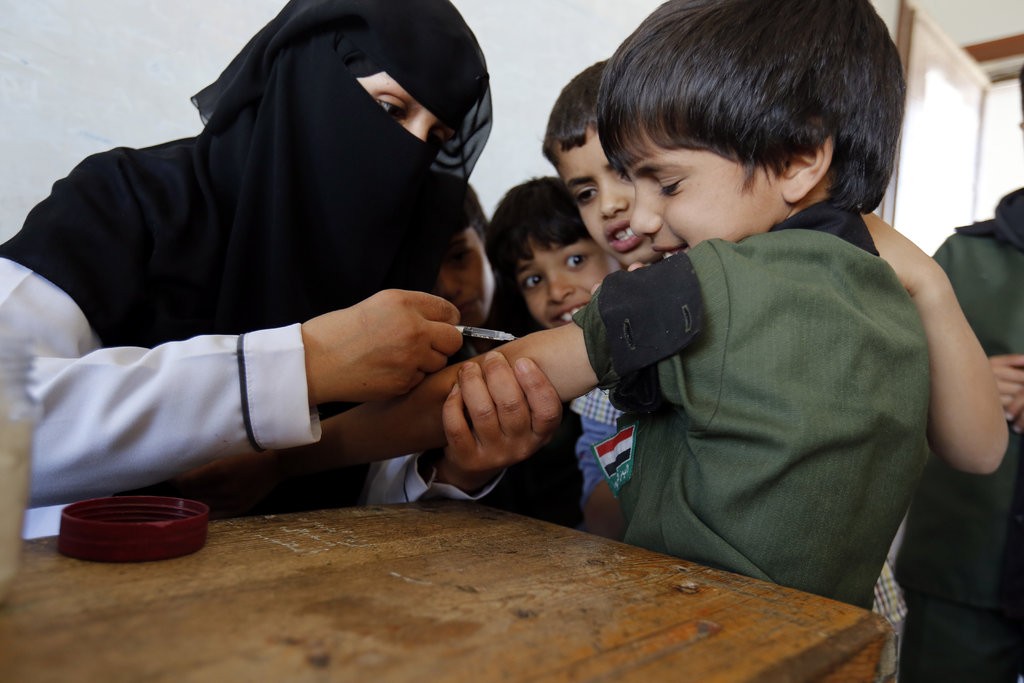
Worldwide cases of measles have increased 30 percent since 2016, the World Health Organization said last year. Credit: Yahya Arhab/EPA, via Shutterstock
Does this mean mumps and rubella cases are re-emerging, too?
The M.M.R. vaccine has also greatly reduced the threat of mumps and rubella in the United States. It is not quite as effective against mumps, with 88 percent effectiveness, according to the C.D.C., and cases have increased in recent years, from 229 in 2012 to 6,366 in 2016.
Rubella used to cause millions of infections in the United States. According to the C.D.C., 12.5 million people got rubella in an epidemic from 1964 to 1965, and the disease caused 11,000 women to lose their pregnancies, 2,100 newborns to die and 20,000 babies to be born with congenital rubella syndrome, which can cause brain damage and other serious problems.
Rubella was declared eliminated in the United States in 2004, and the C.D.C. says that fewer than 10 cases are reported each year. But, as with measles and mumps, there are still many countries where it persists because of lack of vaccination, and every case since 2012 has been traced to people infected while traveling or living in another country.
Pam Belluck is a health and science writer. She was one of seven Times staffers awarded the 2015 Pulitzer Prize for International Reporting for coverage of the Ebola epidemic. She is the author of “Island Practice,” about a colorful and contrarian doctor on Nantucket.
Overuse of the medicines is not just a problem in rich countries. Throughout the developing world antibiotics are dispensed with no prescription required.
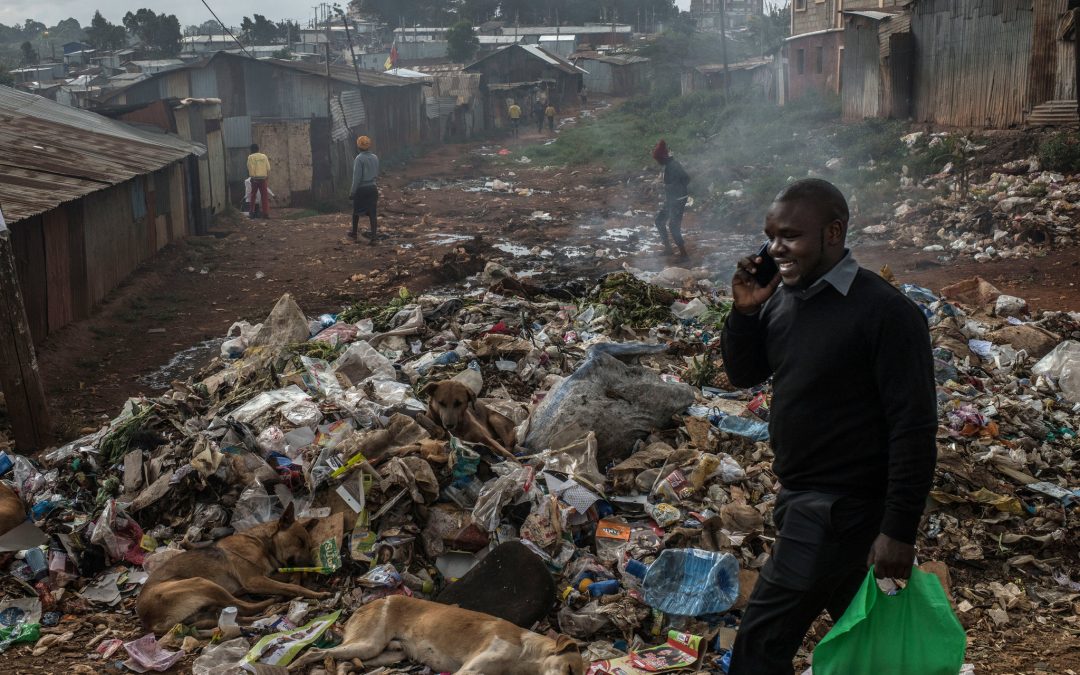
Try your luck at writing a caption for this photograph. Better yet, try an analysis of it.
The story headline is bad. The story is bad. On a smaller scale though, I am struck by the photograph of the man on the cell phone. He’s smiling as we walks across mountains of garbage where (he, and his?) people live, raise children, and go about daily living.
In this staggering story, Kenya is referred to as an emerg-ing economy. A develop-ing country. I’ve added the hyphens because in my eyes, as I have read and witnessed this story play out for decades, it is my conclusion, that too many countries in Africa have not emerged from anything. Media and scholars try to be polite and avoid confrontation by using the “ing” after the country’s name’s, because to label them as un-developed, is a smear. But, I don’t see any other way to put it. It is a smear. It is worse. It is atrocious to witness these realities in the modern age of developed economies all around the planet. Its not just Africa. Its in Asia, South America, and to a lesser extent, small pockets in our own country. But nothing compares with this. What goes on here is astounding, and its been going on as long as I have been alive. There’s no emerging. There’s no developing. Any development or emerging that’s going on is on such a small incremental basis, that its no match to the magnitude of the scourge.
Africa is a complex quagmire of dueling, feuding, conflicted, often rudderless countries, who move in and out of exploitative control of its peoples from one masquerading despot to another. I am not worthy to shine a true scholar’s shoes on this subject, but I do know what I see, or don’t see. I do see serious health consequences bordering on the continent of a nationwide crisis. I don’t see sustained action of several African countries united to work together. Globally, its the same story. Since decolonization, Africa has not been able to rise out of its troubled history of slavery and European exploitation. Yet, they affect us when we stop and take notice when an article like this one lands in front of our eyes. >MB
Read on to find out what you can do to protect whatever you can protect. Its not that difficult, but it does take time. You have to be willing to spend a few minutes. Okay, five, ten, fifteen, whatever. Privacy deserves attention. Does it not? And, by the way, this is not about having something to hide. Its about protecting your data, YOUR DATA, from companies who profit off of YOUR DATA, and offer nothing in return. They’re not giving away software. They are capitalized up the kazoo with billions.
There are plenty of switches in your iPhone settings, or other smartphones, that you can easily switch off and not even notice the loss. If you do, then you can switch them back on. try it. I have, and feel better for yet another thing, or group of things I can do to exert some kind of control on my personal life, that seems to be less and less valuable to the tech companies who are willing to exploit it at will.
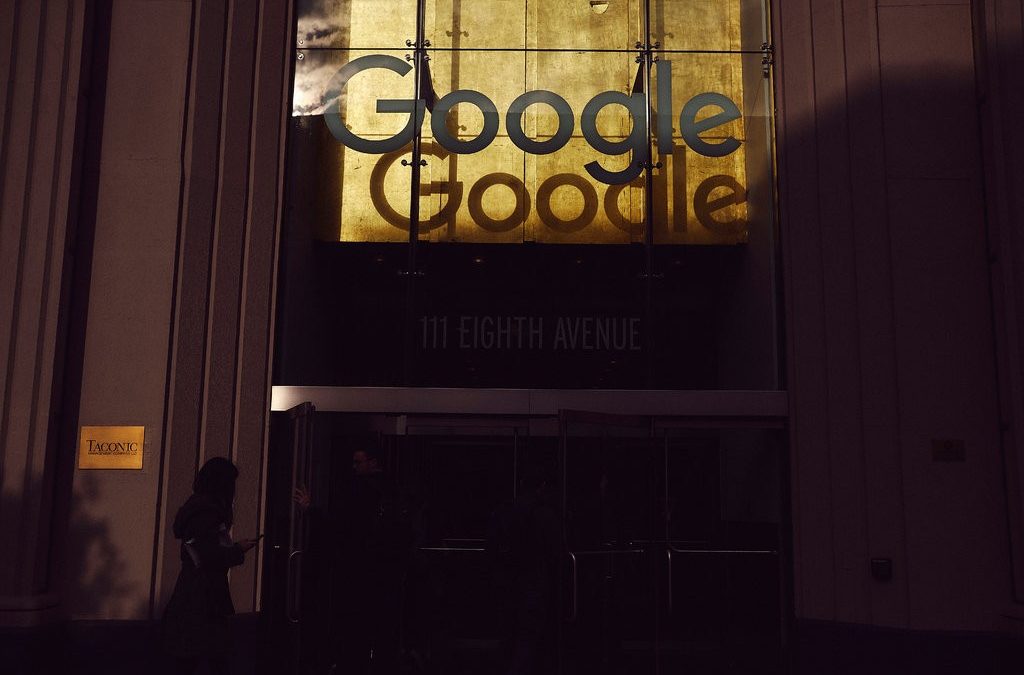
The headquarters of Google in Manhattan. Credit: John Taggart for The New York Times
Google’s Sensorvault Is a Boon for Law Enforcement. This Is How It Works.
Investigators have been tapping into the tech giant’s enormous cache of location information in an effort to solve crimes. Here’s what this database is and what it does.
Law enforcement officials across the country have been seeking information from a Google database called Sensorvault — a trove of detailed location records involving at least hundreds of millions of devices worldwide, The New York Times found.
Though the new technique can identify suspects near crimes, it runs the risk of sweeping up innocent bystanders, highlighting the impact that companies’ mass collection of data can have on people’s lives.
Why does Google have this data?
The Sensorvault database is connected to a Google service called Location History. The feature, begun in 2009, involves Android and Apple devices.
Location History is not on by default. Google prompts users to enable it when they are setting up certain services — traffic alerts in Google Maps, for example, or group images tied to location in Google Photos.
If you have Location History turned on, Google will collect your data as long as you are signed in to your account and have location-enabled Google apps on your phone. The company can collect the data even when you are not using your apps, if your phone settings allow that.
Google says it uses the data to target ads and measure how effective they are — checking, for instance, when people go into an advertiser’s store. The company also uses the information in an aggregated, anonymized form to figure out when stores are busy and to provide traffic estimates. And those who enable Location History can see a timeline of their activities and get recommendations based on where they have been. Google says it does not sell or share the data with advertisers or other companies.
Does Google collect other forms of location data?
Yes. Google can also gather location information when you conduct searches or use Google apps that have location enabled. If you are signed in, this data is associated with your account.
The Associated Press reported last year that this data, called Web & App Activity, is collected even if you do not have Location History turned on. It is kept in a different database from Sensorvault, Google says.
How can I see what data Google has on me?
To see some of the information in your Location History, you can look at your timeline. This map of your travels does not include all of your Sensorvault data, however.
Raw location data from mobile devices can be messy and sometimes incorrect. But computers can make good guesses about your likely path, and about which locations are most important. This is what you see on your timeline. To review all of your Location History, you can download your data from Google. To do that, go to Takeout.Google.com and select Location History. You can follow a similar procedure to download your Web & App Activity on that page.
Your Location History data will appear in computer code. If you can’t read code, you can select the “JSON” format and put the file into a text editor to see what it looks like.
Can I disable the data collection?
Yes. The process varies depending on whether you are on a phone or computer. In its Help Center, Google provides instructions on disabling or deleting Location History and Web & App Activity.
How is law enforcement using the data?
For years, police detectives have given Google warrants seeking location data tied to specific users’ accounts.
But the new warrants, often called “geofence” requests, instead specify an area near a crime. Google looks in Sensorvault for any devices that were there at the right time and provides that information to the police.
Google first labels the devices with anonymous ID numbers, and detectives look at locations and movement patterns to see if any appear relevant to the crime. Once they narrow the field to a few devices, Google reveals information such as names and email addresses.
Jennifer Valentino-DeVries is a reporter on the investigative team, specializing in technology coverage. Before joining The Times, she worked at The Wall Street Journal and helped to launch the Knight First Amendment Institute at Columbia University. @jenvalentino
A version of this article appears in print on , on Page A19 of the New York edition with the headline: Google’s Sensorvault: Here’s How It Works. Order Reprints | Today’s Paper | Subscribe