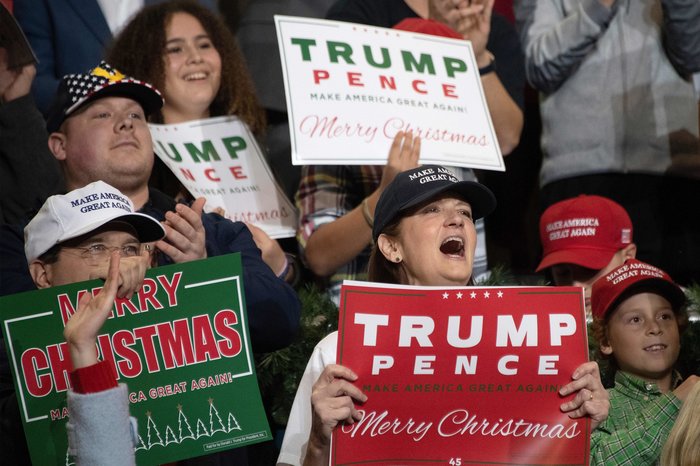
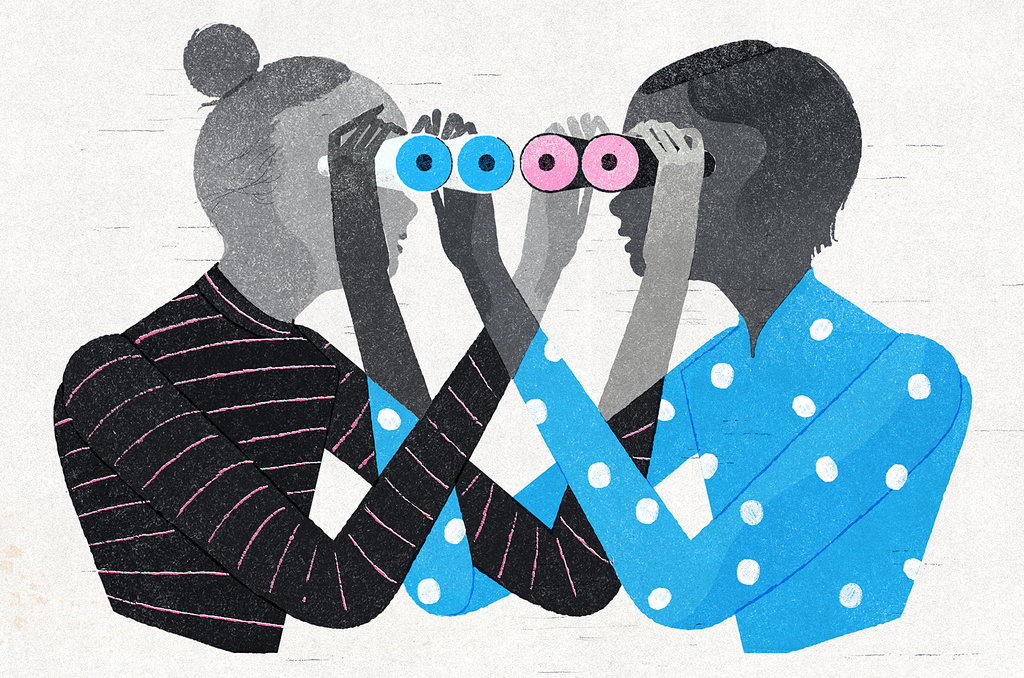
Thinking, about this headline. Thinking, I agree. Thinking, that one, one of the key issues for my distaste of Trump, may very well have been his association with the Right side of government, and it’s ideology. In this regard, the question to all of us left of center and beyond, is how we’d have been, would be, with a left sided Trump? I know my answer. What’s yours?
Thing is, Trump’s problem, mostly, is that he’s… hmmm… an imbecile.
For me, being politically incorrect is generally more of a good thing, than bad. For that, Trump gets decent marks. The country, humanity even, deserves, needs, a departure from the old line boilerplate politician that essentially took over this country after the WWII.
This isn’t the place for that longish essay. It’s just a shortcut sentence to my point, and this article below.
Again, the issue with Trump… he’s an imbecile. We don’t need that.
Heading into the 2020 Democratic primaries, a new NPR/PBS NewsHour/Marist poll has a warning for Democrats: Americans are largely against the country becoming more politically correct.
Fifty-two percent of Americans, including a majority of independents, said they are against the country becoming more politically correct and are upset that there are too many things people can’t say anymore. About a third said they are in favor of the country becoming more politically correct and like when people are being more sensitive in their comments about others.
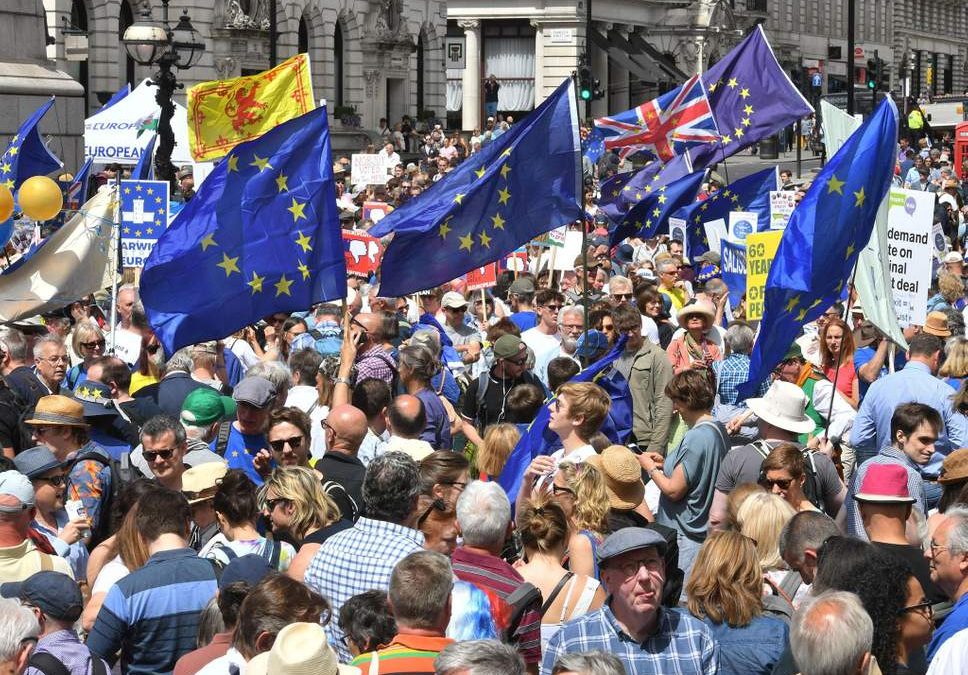
It certainly is true that Brexit, and the relationship with the EU is complicated. But, the reasons why this leave/don’t leave conflict has become a two year long fiasco mess that it is today, is not as complicated.
The general public, the voting masses of citizens, the vast electorate, the rank and file, the mainstream who hold ordinary jobs, many who struggle to provide, survive, and most importantly, do not own a life of politics, all too often fail to study a societal problem to the depths it requires.
Ignorance, naïveté, laziness, misguided trust, or, even given proper analysis, just flawed reasoning, all fill the bucket of excuses that explains these events.
Combine these habitual very human shortfalls with millions of impassioned, clashing opinions, and you get a vortex of downward spiraling conflicts that drags everything into it.
Politicians, government legislators, for all their flaws, their corruption, their weaknesses, their lies, and their greed, are genuinely driven, dedicated individuals, who have a very specific job to do. Research, study, and analyze a problem or situation, and form an informed opinion of action to address that situation or problem. Whether their ultimate position serves them, or their constituents selfishly, or with a measure of greater good thinking, is besides the point.
The definition, or outcome, of right or wrong is not relevant. The point is, there was a very specific, step by step process that is undertaken to help make a decision, take a stand, or propose a solution to the situation or problem.
In the UK, as in the U.S., and increasingly, around the world, the citizenry aggregate, is unwilling, uncommitted, to put the same work into understanding and executing this same process before they present their own opinions.
Until this changes, there will be more crisis and havoc before there is resolution and stability.
MB
Theresa May Survives Leadership Challenge, but Brexit Plan Is Still in Peril
Two and a half years after Britain’s referendum on whether to leave the European Union, the country remains divided. We met with voters on both sides of the debate — those who voted to leave and now feel betrayed, and those campaigning for a second referendum
By Stephen Castle, NYTimes
LONDON — Britain’s prime minister, Theresa May, survived the gravest threat yet to her embattled leadership on Wednesday, winning a party confidence vote and averting a leadership battle that threatened to plunge the country into prolonged crisis.
But the victory celebration, if any, is likely to be short-lived.
While Mrs. May survived to fight another day, the future of her stalled plan to leave the European Union looked bleaker than ever.
She still lacks the votes in Parliament to pass it. She stands little chance of winning the concessions from Europe that she needs to break the logjam.
And the surprisingly strong vote against her within her own party underscores the difficulty she faces in winning approval for any plan for Britain to leave Europe, or Brexit, as the deadline for withdrawal looms.
For one moment, however, after a week of humiliating setbacks, the prime minister could savor her win.
Prime Minister Theresa May outside 10 Downing Street after she survived a confidence vote on Wednesday.
“Here is our renewed mission,” she said outside her offices at 10 Downing Street after the vote on Wednesday. “Delivering the Brexit that people voted for, bringing the country back together and building a country that truly works for everyone.”
But even that moment was tempered by loss.
Mrs. May won the vote only after promising that she would step aside soon after the Brexit agonies were over, according to reports from a meeting of Conservative Party lawmakers preceding the vote. That pledge removed the generally unwelcome possibility that she would stand as party leader in the next general election.
Mrs. May, said George Freeman, a Conservative lawmaker, had made clear “that she has listened, heard and respects the will of the party that once she has delivered an orderly Brexit, she will step aside for the election of a new leader.”
In the vote on Wednesday, on a confidence motion called by her own Conservative Party, Mrs. May won the support of 200 Conservative lawmakers, while 117 voted against her. The protest vote exceeded many forecasts, and is expected to compound her difficulties in Parliament, where her enemies were already pressuring her.
“This was a terrible result for the prime minister,” said Jacob Rees-Mogg, a leader of the hard-line pro-Brexit faction.
The vote does give her some breathing room. Under the Conservative Party’s rules, she cannot be challenged again by her own lawmakers for another year, which at least offers some stability for moving the Brexit plan forward. Had she lost, the Conservatives would have been thrust into a divisive, drawn-out process that would have stretched well into the next month.
Graham Brady, the chairman of the 1922 committee, the body that represents Conservative backbenchers, announcing that Theresa May survived the confidence vote.
The delay would have threatened the country’s ability to reach a deal by the March deadline, potentially resulting in the messy prospect of a no-deal Brexit.
Nevertheless the victory came at a price, laying bare the opposition within her own party ranks to Mrs. May, who leads a government that has no parliamentary majority.
The confidence vote was called after weeks of discord when at least 48 Conservative lawmakers submitted the letters of protest required to force it. Mrs. May canceled a trip to Dublin where she had hoped to talk to her Irish counterpart, Leo Varadkar, about changes that might help build support in the British Parliament for her Brexit proposals.
But it had already been clear that she was in deep political trouble, battered from multiple directions by her management of the European Union withdrawal. In particular, many hard-line Brexit supporters within her party believed she was not making a complete enough break with the bloc.
In recent days, she suffered two embarrassing setbacks. Last week, the House of Commons voted her government in contempt of Parliament — the first time any prime minister had been censured in that way — for failing to release the advice her government’s lawyers had given on Brexit.
And on Monday, she postponed a vote on the Brexit agreement she had negotiated with the European Union, acknowledging that it stood to be defeated by “a significant margin.” In fact, lawmakers say, views on the topic, which has dominated British politics for nearly three years, are so fragmented that no approach has majority support in Parliament, and probably not even among Conservatives.
May’s Brexit Deal Is Probably Still Going to Fail. What Happens Then?
Nobody knows, really. But these are the likeliest scenarios.
Mrs. May argued Wednesday morning that the only beneficiaries of a vote of no confidence would be the opposition Labour Party.
Having survived it, she now faces an uphill task to garner sufficient support for her withdrawal agreement with the European Union, a lengthy legal document that Brussels has warned is the only deal on the table.
John Springford, deputy director of the Center for European Reform, a London-based research institute, said that the size of the vote against her “is an even clearer signal that she won’t be able to get her deal through Parliament, and makes it even more likely that when she puts the deal to the vote she will lose that.”
On Thursday she is scheduled to travel to Brussels to meet leaders of the 27 other European Union countries to try to secure some reassurances that might help her win a vote on the Brexit plans. She has promised to allow lawmakers to decide the matter by Jan. 21. If there is no agreement then, Britain could be facing a chaotic departure on March 29.
Or not. There could be a second referendum, a mutually agreed extension of the negotiating period or even, as Mrs. May has warned her party, no Brexit at all. What does not seem to be in the cards, for now, at least, is the general election that the opposition Labour Party leader, Jeremy Corbyn, has been angling for throughout the Brexit process.
While Mrs. May has maintained a public face of optimism over securing some pledges from the European Union intended to reassure her own lawmakers, she is unlikely to win any game-changing concessions.
Mrs. May in the House of Commons on Wednesday
Her strategy appears to be to delay the critical vote — now probably in the middle of January — and to hope that the growing risk of a disorderly departure brings some lawmakers back into line. But many doubt that will work.
“Clearly, her last throw of the dice is count down the clock and try to bounce people into voting for it,” Mr. Springford said. “But I am not convinced she will win that vote. I don’t think that she can get meaningful concessions from the European Union that would be enough to get her over the line.
“The best hope is that everybody calms down over Christmas, that they start to really worry about no deal, and that some more moderate people signal that they will support her. But everyone is now so high up their pole that I am not sure they can climb down.”
In Brussels, diplomats said they could see little benefit from Mrs. May’s travails, and that no new British leader would be able to change the fundamentals of the 585-page divorce agreement negotiated so painfully.
That applies to the so-called backstop that the pro-Brexit lawmakers are particularly incensed about. That provision would insure the free movement of goods over the Irish border in the event that a free-trade agreement is not reached in the two-year transition period after Brexit. What is especially galling for the Brexiteers is that it would continue indefinitely, or until the European Union decides it is no longer needed.
The main fear is that there is no majority in Parliament for any kind of Brexit deal, one diplomat said, speaking on condition of anonymity according to diplomatic protocol.
“Even the funny elements of this are actually tragic,” said another diplomat. “I still hope Beckett, Kafka and Havel are not those who will finish writing this piece.”
Steven Erlanger contributed reporting from Brussels.
Products that we enjoy continue to create privacy, misinformation and workplace issues. We can do better at getting the industry to do better.
Via NYTimes, By Brian X. Chen
It has never felt worse to be a technology consumer. So what can you do about it?
That’s the question of the year after many of the biggest tech companies were mired in scandal after scandal or exposed as having committed necessary evils to offer the products and services that we have so blissfully enjoyed.
Those instant Amazon deliveries? They sure are convenient, but Amazon warehouse workers in Europe protested the company during Black Friday, describing their working conditions as inhuman.
You might have considered deleting Facebook after the social network confessed that Cambridge Analytica, a political consulting firm, had improperly obtained the data of millions of users. If that didn’t convince you, maybe the security breach exposing the data of 30 million Facebook accounts did.
All of this bad behavior circles back to you. We are the buyers, users and supporters of the products and services that help Big Tech thrive.
So what do we do at this point to become more ethical consumers?
“I think this is an incredibly powerful question to ask,” said Jim Steyer, chief executive of Common Sense Media, a nonprofit that focuses on technology’s impact on families. “It’s a very important moment where consumer behavior can have a transformational impact.”
I talked to a broad range of people — ethicists, activists, environmentalists and others — about how to become a more empowered, socially responsible tech consumer. Here’s what they agreed on.
Boycott and Shame
First and foremost, when tech does you wrong, one of the most powerful ways to protest is to take your business elsewhere and ask your friends and family to go along.
Last year, hundreds of thousands of customers abandoned Uber in favor of alternatives like Lyft after the ride-hailing company’s many scandals, including repeated accusations that it turned a blind eye to sexual harassment. That choice became a movement known as #DeleteUber. This year, people frustrated with Facebook took part in a #DeleteFacebook campaign.
The financial impact of these actions may not have been huge. Uber continues to grow (while still losing money) as it marches toward an initial public offering. Facebook has reported increased profits, though its user growth has slowed.
Even so, damage to a brand may have plenty of repercussions because it motivates the company to change its behavior, Mr. Steyer said. Both Uber and Facebook, facing enormous pressure, have modified some of their practices and committed to improvements.
“Sometimes shame is one of the most important arrows in your quiver,” Mr. Steyer said.
Give Up Convenience for Independence
We can also take the path less traveled — that is, take our data and money to products made by more ethical vendors.
Many people have hesitated to delete Facebook because doing so felt futile. Facebook is an all-in-one place for discovering local events, reading news, watching videos and staying connected to friends and family. The company also owns Instagram and WhatsApp, two of the largest photo-sharing and messaging services.
Pulling the plug on Facebook is a hassle, but not impossible. Taking on the challenge of finding alternatives is an example of how people can give up some convenience in exchange for individual empowerment, said Shahid Buttar, a director of grass-roots advocacy for the Electronic Frontier Foundation, a digital rights nonprofit.
There is no direct replacement for something as convenient as Facebook. But if you go piecemeal, Mr. Buttar said, there are options. These include using an RSS reader, a software tool for getting a comprehensive feed of news sources that are self-curated; messaging people with a service like Signal, which is open-source software; and looking up events on organizing services like Meetup.
The same approach can be applied to Google if you take issue with its behavior. While Google offers a comprehensive suite of web services, including news, email and maps, you could switch to an alternative for each of those products.
A chief example: When ordering from Amazon or other online retailers, think twice before you opt for same-day or overnight delivery, even if it’s free. Other than the human toll of fast service, which has included miscarriages by pregnant workers at Verizon warehouses, there is an environmental impact.
A rush shipment could involve multiple vehicles and various facilities before it gets to your door. So pause and ask yourself if you actually need that smartphone or scented candle tomorrow. If you can wait, choose no-rush delivery, which could take about a week.
You can reduce your environmental impact further by delaying how often you upgrade technology. That can be achieved by regular maintenance of devices, including smartphones, laptops and tablets.
Vincent Lai, who works for the Fixers’ Collective, a social club in New York that repairs aging devices, said people could become more empowered by repairing, maintaining and modifying products to escape the upgrade cycle that tech companies impose.
When your smartphone seems to be slowing down, for instance, take steps to speed it back up by purging some photos and apps to clear storage, replacing an aging battery or reinstalling the operating system.
“One of the things you can do to be more responsible is to take greater ownership of your stuff,” Mr. Lai said.
Think About Your Friends
The Cambridge Analytica scandal this year illustrates our responsibility to think about others, not just ourselves, when using technology.
When Cambridge Analytica worked with a researcher who distributed a questionnaire app on Facebook to about 270,000 Americans, people who responded to the questions unwittingly shared data about their Facebook friends. As a result, the personal information of 87 million people was harvested to create voter profiles and to target political messages.
The sharing of friends’ data might have been prevented if Facebook users had been aware of their privacy settings. One now-defunct setting was called Apps Others Use, which controlled the information that your friends shared about you when they used apps, including your birthday or hometown.
In other words, if people had disabled Apps Others Use, Cambridge Analytica most likely couldn’t have collected the data of their friends. More important, if those who took the quiz were aware of the potential of sharing information about their friends, they might have opted not to participate.
But how can you be more conscious of your actions when technology is so confusing in the first place?
Education is key. Mr. Buttar said a network of 85 groups that make up the Electronic Frontier Foundation Alliance hosted workshops across the United States that taught people more about issues like digital privacy and data protection. And many online forums and publications track these issues closely.
The bottom line is that you are not alone. And if a company makes it too difficult for you and your friends to stay safe while staying connected, you can leave.
“If you’re really uncomfortable with the values of a company, don’t use their product,” Mr. Steyer said.
Read more about how to keep yourself safe and be less wasteful with technology.
Brian X. Chen is the lead consumer technology writer. He reviews products and writes Tech Fix, a column about solving tech-related problems.
WASHINGTON — The Trump administration is expected on Tuesday to unveil a plan that would weaken federal clean water rules designed to protect millions of acres of wetlands and thousands of miles of streams nationwide from pesticide runoff and other pollutants.
Environmentalists say the proposal represents a historic assault on wetlands regulation at a moment when Mr. Trump has repeatedly voiced a commitment to “crystal-clean water.” The proposed new rule would chip away at safeguards put in place a quarter century ago, during the administration of President George H.W. Bush, who implemented a policy designed to ensure that no wetlands lost federal protection.
“They’re definitely rolling things back to the pre-George H.W. Bush era,” said Blan Holman, who works on water regulations with the Southern Environmental Law Center. Wetlands play key roles in filtering surface water and protecting against floods, while also providing wildlife habitat.
President Trump, who made a pledge of weakening a 2015 Obama-era rule one of his central campaign pledges, is expected to tout his plan as ending a federal land grab that impinged on the rights of farmers, rural landowners and real estate developers to use their property as they see fit.
Under the Obama rule, farmers using land near streams and wetlands were restricted from doing certain kinds of plowing and planting certain crops, and would have been required to apply for permits from the Environmental Protection Agency in order to use chemical pesticides and fertilizers that could have run off into those water bodies. Under the new Trump plan, which lifts federal protections from many of those streams and wetlands, those requirements will also be lifted.
A spokesman for the Environmental Protection Agency, John Konkus, declined to comment on the plan.
The clean water rollback is the latest in a series of actions by the Trump administration to weaken or undo major environmental rules, including proposals to weaken regulations on planet-warming emissions from cars, power plants and oil and gas drilling rigs, a series of moves designed to speed new drilling in the vast Arctic National Wildlife Refuge, and efforts to weaken protections under the Endangered Species Act. This week in Katowice, Poland, at an annual United Nations conference on mitigating global warming, Trump administration officials held an event touting the benefits of fossil fuels.
The proposed water rule, scheduled to be announced Tuesday morning at the Environmental Protection Agency, is designed to replace an Obama-era regulation known as Waters of the United States. Tuesday’s unveiling of the proposal is expected to coincide with its publication in the federal register. After that, the administration will take comment on the plan for 60 days, and it could then revise the plan before finalizing it next year.
The Obama rule, developed jointly by the E.P.A. and the Army Corps of Engineers under the authority of the 1972 Clean Water Act, was designed to limit pollution in about 60 percent of the nation’s bodies of water, protecting sources of drinking water for about a third of the United States. It extended existing federal authority to limit pollution in large bodies of water, like the Chesapeake Bay and Puget Sound, to smaller bodies that drain into them, such as tributaries, streams and wetlands.
But it became a target for rural landowners, an important part of President Trump’s political base, since it could have restricted how much pollution from chemical fertilizers and pesticides could seep into water on their property.
The new Trump water rule will retain federal protections for those larger bodies of water, the rivers that drain into them, and wetlands that are directly adjacent to those bodies of water, according to a detailed eight-page fact sheet prepared by the administration ahead of the unveiling of the rule and reviewed by The New York Times.
But it will strip away protections of so-called “ephemeral” streams, in which water runs only during or after rainfalls, and of wetlands that are not adjacent to major bodies of water, or connected to such bodies of water by a surface channel of water. Those changes represent a victory for farmers and rural landowners, who lobbied the Trump administration aggressively to make them.
“The Obama administration led with the premise that all water is connected, all water runs downhill, and the federal government could control all water,” said Don Parrish, director of regulatory relations with the American Farm Bureau Federation, who met with White House officials over the summer to press the case for those changes.
“If they can control the water that falls out of the sky, they control the land that it falls on,” he said.
Mr. Parrish also said the Obama rule chafed its detractors because of the perception it was written by bureaucrats who did not understand the daily reality of farmers’ livelihoods. “The last administration called our concerns silly and ludicrous, and this administration took us seriously. They listened to us,” he said.
In particular, he cited a social media campaign run by the Obama administration, “Ditch the myth,” which challenged the claim that the rule would have regulated water in ditches. “With that campaign, they were laughing at us,” he said.
Mr. Trump won cheers from rural audiences on the presidential campaign trail when he vowed to roll back the Obama rule. Real estate developers and golf course owners (industries in which Mr. Trump worked for decades) were also among the chief opponents of the earlier rule. One of Mr. Trump’s first actions in office was to sign an executive order directing his E.P.A. chief to repeal and replace the rule.
To environmentalists, however, the proposed rule change “upends the core mission of the E.P.A., which is to protect human health and the environment,” said Bart Johnsen-Harris, who works on water policy at the Environment America, an advocacy group.
While the Obama rule would have applied federal protections to wetlands that are not adjacent to major bodies of water, or do not directly drain into them via a surface water channel, the new rule will strip away that protection. That potentially opens millions of acres of pristine wetlands to more pollution, according to Mr. Holman of the Southern Environmental Law Center.
“For wetlands, this is an absolute disaster, compared to the Obama plan,” he said. While such wetlands may not be physically next to major bodies of water, they can still drain into such larger bodies through underground networks, Mr. Holman said.
Stripping away those protections would still allow pollution to seep into the nation’s broader waterways, he said. It would also make it easier for developers to pave over such wetlands.
Federal courts had already halted the implementation of the 2015 Obama-era rules in 28 states after opponents sued to block them. However, in recent months the rules had taken effect in the other 22 states.
The wetland protection policies put in place decades ago by the first President Bush, an avid fisherman, followed on his own campaign pledge to save wetlands, saying, “all wetlands, no matter how small, should be preserved,” and proposing a “no net loss” policy. That initial policy was later weakened by Mr. Bush’s own E.P.A., but environmentalists have credited him for elevating the issue.
Fifteen years later, the second President Bush gave regulatory teeth to his father’s proposal, implementing an E.P.A. rule requiring stronger wetlands protection that his father had once envisioned.
This is a very serious problem that is surely underestimated in its negative societal impacts. Children lacking empathy grow into adults lacking it. Once in adulthood, empathy is much harder to teach and appreciate. More focus needs to be placed on this with children, teenagers, and really, all of us. Its a tremendous part of humanity.
New York Times
Research shows that we are each born with a given number of neurons that participate in an empathetic response. But early life experience shapes how we act on it.
As the year’s end approaches, most Americans get bombarded by emailed and snail-mailed requests for donations to all manner of charities, A to Z.
I’m an easy target, a softy readily seduced by impassioned pleas to help improve the well-being of people, animals and the environment, and I often respond to more appeals than my earnings warrant.
This year will be different, thanks to advice from one of the leading experts on empathy, Dr. Helen Riess, associate professor of psychiatry at Harvard Medical School and author of a new book, “The Empathy Effect,” that explores the neuroscience behind concern for others and offers advice on how to nurture and implement it most effectively.
Instead of a scattershot of small gifts to a dozen or more charities, Dr. Riess suggested in an interview that I “pick one or two where a more substantial contribution can really make a difference.” She told me to use “cognitive empathy,” a more rational, less emotional approach. Empathy doesn’t mean saying “yes” to every request, she emphasized. “Recognize that you can’t save the world, and give to organizations that are most important to you.”
Let something from your own life experience determine which issues are closest to your heart and most deserve your money, she suggests in her book. For me, that would be education and food security; I’ll leave it to others to save abandoned pets and the planet this year.
Perhaps no one knows the importance of balancing feelings with thoughts better than Dr. Judith Orloff, a Los Angeles-based psychiatrist and the author of “The Empath’s Survival Guide.” Her book can help highly sensitive people avoid taking on everyone else’s needs and problems, which Dr. Riess says can lead to “compassion fatigue” and burnout.
“There’s healthy giving and there’s unhealthy, codependent giving that can ultimately make you feel worse,” Dr. Orloff said in an interview. “It’s important to be empathetic but also to set healthy limits and boundaries rather than being a doormat. If you’re a highly sensitive person, you have to learn how to channel your energy. Healthy empathy is when you give from your heart, but not martyr yourself.”
She added, “You have to practice self-care. ‘No’ is a complete sentence — no explanation needed.” If that seems too abrupt, ‘I’m sorry but I can’t do that’ is a reasonable add-on.
While overly empathetic individuals can be their own worst enemy, more distressing to me, at least, are people who seem deficient, even devoid, of empathy. They are self-focused, narcissistic, always thinking about what’s in it for them and never recognizing and responding to the needs of others, a deficit that can undermine human survival, which depends on community support.
Research by Dr. Riess and her collaborators has shown that we are each born with a given number of neurons that participate in an empathetic response. But whether this potential to care appropriately for one’s fellow beings is realized or undermined is largely molded by early life experiences, starting at birth and continuing throughout childhood.
How, then, can a healthy degree of empathy be instilled in a child? “Empathy is a mutable trait, it can be taught,” Dr. Riess told me. “We’re all born with a certain endowment, but it can be dramatically up-regulated or down-regulated depending upon environmental factors,” especially, she said, by the examples set by a child’s caregivers.
Dr. Riess urges parents to be role models who show respect and caring for others: “Billy scraped his knee. Let’s go get a Band-Aid for him,” or “Mrs. Jones just came home from the hospital. Let’s take her some soup.”
Teachers and caregivers in child care and pre-K settings can foster empathy by acknowledging rather than dismissing a child’s distress or by bringing a toy or doll to comfort a child who is upset or injured. Libraries and bookstores are replete with stories in print and video that demonstrate the giving and receiving of empathy for children at different age levels. Among the many choices: “I Am Human,” “What’s Wrong with Timmy?” and a personal favorite, “Wonder,” which was also made into a popular movie last year.
Dr. Riess has vivid memories of how her parents demonstrated empathy, by bringing turkeys before Thanksgiving to the homes of people who had almost nothing. “Kids tend to focus on what they don’t have — this exposes them to people who have so much less and gives them the gift of being a giver.”
She told me of a program called Cradles to Crayons, in which volunteers package up donated items for children in need. The program, currently operating in Boston, Philadelphia and Chicago, provides essential items for needy children from birth through age 12.
With older children, parents might take them to help out in a soup kitchen or visit a nursing home, Dr. Riess suggested. “It’s never too late to guide a child toward greater appreciation of others’ feelings,” she wrote.
Equally important is for parents to demonstrate empathy with their own children by acknowledging their concerns and feelings and recognizing their need for security. For example, she said, “When a child is fearful of a dog, instead of saying ‘Don’t be afraid, he won’t bite you,’ say ‘Are you scared of the dog? What scares you?’ This validates the child’s fears rather than negating them.”
At the same time, Dr. Riess said, parents should not overreact by being intolerant of “a single second of unhappiness in their child’s life” lest such misguided empathy deprive the child of developing the grit, perseverance and resilience that is essential to a successful life.
Parents can talk to their children about other people’s feelings. If a child breaks another child’s toy, Dr. Riess suggests that instead of saying “‘Why did you do that? That was bad,’ say ‘Sara is sad because you broke her toy. What can we do to make up for that?’ which leaves the door open for an apology.”
Also helpful is to “validate your child’s difficult emotions instead of being judgmental,” she said. “If the child says ‘I hate Tommy,’ rather than say it’s wrong to hate, ask what makes the child feel that way. Explore what’s behind the feelings, the back story.”
For very young children, stuffed animals or puppets can be used to help them act out different stories, Dr. Riess suggested.