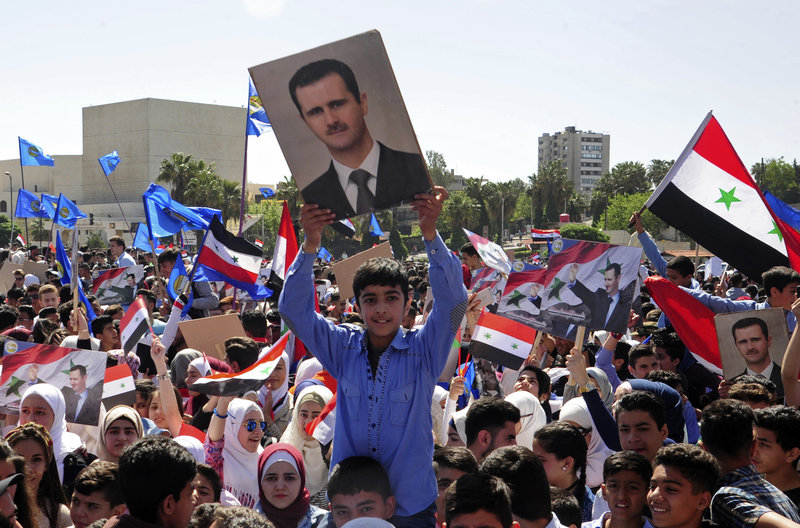
A crowd in central Damascus waves flags and portraits in support of President Bashar Assad on Monday, two days after the U.S., Britain and France carried out airstrikes. The photo was released by the official Syrian news agency SANA.-AP
Your article has a good headline, but you write almost nothing that actually answers the question you posed. It’s very difficult to do, but you could’ve tried. You did not, and that’s the problem with current mainstream journalism. It does not provide depth of analysis to complicated world problems. Even respectable outlets like NPR, apparently, are not raising the bar on their writers to go deeper.
Good news sources exist that do provide viable explanations and historical perspective of the Middle East quagmires, and other intractable conflicts around the globe, as well as, complicated national issues, but too many people never read those sources, because they are not deeply interested enough. So, it’s left to mainstream disseminators to inform most of the public what’s going on around them. Unfortunately, they don’t do a good enough job, and that is yet another topic that needs deeper discussion.
President Trump called Syrian leader Bashar Assad a “monster” on Friday night as he announced airstrikes to punish Assad for an apparent chemical weapons attack against Syrian civilians.
On Saturday morning, a tweet by the Syrian Presidency account showed a video of Assad walking into the presidential palace in Damascus wearing a dark suit and tie, briefcase in hand — business as usual.
By Sunday night, the White House issued a statement stressing that the U.S. would not be drawn into the wider war.
“The U.S. mission has not changed — the president has been clear that he wants U.S. forces to come home as quickly as possible,” White House Press Secretary Sarah Sanders said.